
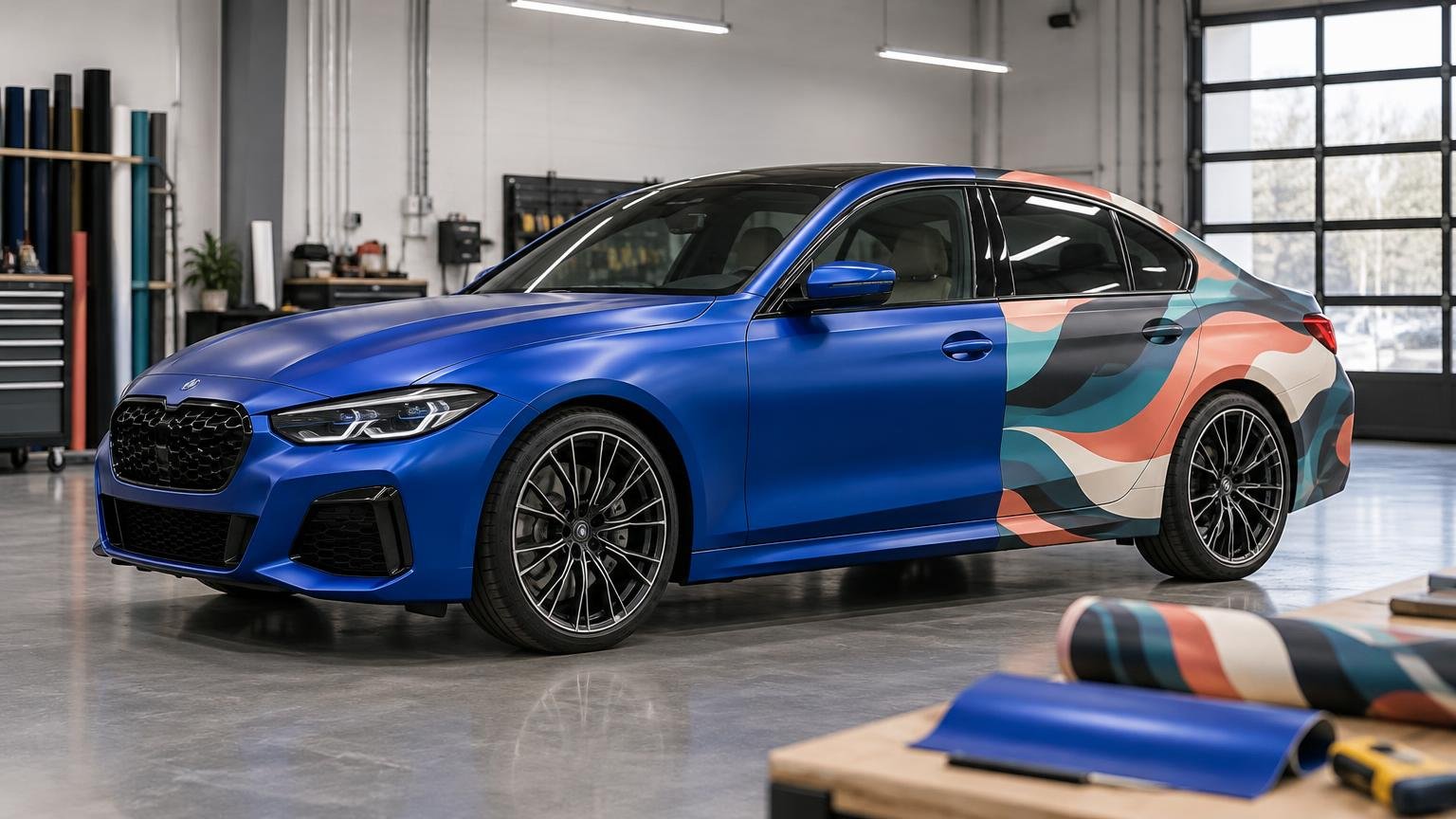
Choose a printed wrap when the design requires logos, photographs, illustrations, gradients, camouflage, contact information, or a controlled multi-color layout. Choose color-change film when the goal is a consistent new exterior color or a specialty finish such as satin, matte, high gloss, a pattern, or a texture.
That is the practical dividing line. A printed wrap turns a digital design into vehicle graphics. A color-change wrap starts with film manufactured in a particular color and finish. Both can cover an entire vehicle, and both can use premium cast film suitable for demanding bodywork. The right choice depends first on the appearance you want, then on the vehicle, installation plan, maintenance expectations, and complete quoted system.
The difference is customization versus a prefinished surface
A print-wrap system usually begins with printable white film. Ink creates the artwork, and a compatible clear overlaminate is selected to protect the print and provide the intended surface finish. For example, the 3M IJ280 product bulletin describes a white cast wrap film compatible with solvent, UV, and latex printing, with its protective layer selected separately.
Color-change film arrives with its visible color and surface character already built in. 3M Wrap Film Series 2080, for example, is a multilayer cast film offered in opaque colors and finishes that include gloss, high gloss, satin, matte, patterns, and textures. The manufacturer positions it for accents, partial decoration, and complete color-change applications.
Do not confuse “printed” with “glossy” or “color change” with “matte.” A printed wrap can receive different laminate finishes. Avery Dennison’s DOL Z overlaminate range, for example, includes gloss, matte, and luster options for compatible digital media. The difference is how the visual result is produced, not whether the finished wrap reflects light.
| Project goal | Better starting point | Why |
|---|---|---|
| One consistent new body color | Color-change wrap | The visible color and finish are manufactured into the film. |
| Company logos and contact details | Printed wrap | The complete branded layout can be printed with controlled placement and color. |
| Photographs, gradients, or detailed illustrations | Printed wrap | Digital printing can reproduce detail that cannot be supplied as one prefinished color. |
| Satin, matte, gloss, textured, or patterned restyle | Color-change wrap | The desired surface can be selected from an available film line. |
| Mostly solid color with one detailed logo | Hybrid system | A color-change base can be paired with separately produced graphics when compatibility is confirmed. |
| Mixed fleet with the same branding | Printed wrap | Artwork can be adapted to different vehicle shapes while preserving a recognizable system. |
When a printed wrap is the better choice
Printed graphics are the clear choice when the vehicle must communicate something specific. A delivery van carrying a logo, phone number, services, and product photography is not primarily changing color; it is becoming a designed business surface. The same applies to promotional vehicles, event graphics, complex racing-inspired layouts, and artwork that must cross several panels in a planned sequence.
Printing also provides more control over where visual elements appear. A designer can keep text away from door handles, move a face away from a panel seam, or scale a gradient around a wheel arch. That flexibility becomes especially valuable across a fleet, although each vehicle class still needs its own layout rather than a blindly enlarged master file. For a multi-vehicle program, use a fleet wrap system that adapts to vans, trucks, and cars.
The production file matters as much as the concept. Color management, panel dimensions, bleed, image resolution, cutting paths, and reprint records all affect the finished vehicle. The printer’s RIP software translates the artwork into instructions for a particular printer, ink, film, and production workflow; RIP controls for printed vehicle graphics are therefore part of repeatable output, not an invisible technical detail.
A printed wrap is not automatically the right answer just because a design uses two colors. Simple identifiers may be more efficiently produced as cut vinyl lettering, while a mostly solid restyle may use color-change film with a limited printed overlay. Match the system to the actual visual job rather than ordering maximum coverage by default.
When color-change film is the better choice
Color-change film is usually the cleaner answer for a personal vehicle owner who wants the car to read as one new color or finish. It avoids manufacturing a printed approximation of a solid color when a suitable prefinished film already exists. The result can feel more like a deliberate restyle because the selected surface remains consistent across the design rather than serving as a background for graphics.
It is also well suited to selective accents. A roof, hood, mirrors, pillars, or trim can receive a contrasting film without requiring a full printed design. The available palette is limited to the current range offered by the chosen manufacturer, however. If an exact corporate color, unusual gradient, or artwork-specific combination is mandatory, a printed system may offer more practical design control.
Avoid treating color-change film as generic printable media. 3M states that printed applications on its 2080 film require testing and approval and are not warrantied as printed applications. If the job calls for extensive printing, specify a purpose-built print-wrap system instead of assuming any visually suitable roll can perform the same role.
Neither category is automatically easier to install
“Printed is harder” and “color change is easier” are unreliable shortcuts. Installation difficulty depends on the exact construction, thickness, stiffness, adhesive behavior, panel geometry, and installer’s technique.
Premium cast options exist in both categories. 3M identifies IJ280 printable film for applications ranging from flat panels to deep channels and recesses, while 2080 is a cast film intended for full vehicle coverage. That does not mean every film can handle every bumper, channel, or compound curve. The product bulletin for the named film must match the vehicle and application.
A printed system introduces production and lamination steps before installation. A compatible overlaminate can improve handling as well as resistance to ultraviolet exposure and wear, but the finished construction must still be installed as a complete system. Adding layers is not universally helpful: 3M warns that applying an overlaminate to 2080 makes that color-change film stiffer and more difficult to install.
The vehicle can matter more than the category. Smooth doors are forgiving compared with deep channels, sharp body lines, textured trim, complex bumpers, and areas with limited access. For full coverage on difficult geometry, premium cast film is the prudent starting point; the distinction between cast and calendared wrap film can be more consequential than whether the visible design is printed or prefinished.
Compare complete quotes, not assumptions about price
Neither printed nor color-change wraps are always cheaper. A printed quote can include artwork, proofs, output, ink, laminate, panel finishing, installation, and possible future reprints. A color-change quote can vary with the selected finish, film availability, coverage detail, disassembly, panel complexity, and the amount of edge work required.
Ask each shop to quote the same scope. “Full wrap” may not answer whether door jambs, deep returns, roof sections, spoilers, handles, mirrors, or exposed original paint are included. A lower number can simply describe less coverage.
- The exact manufacturer and product family for the film
- For printed graphics, the ink and compatible overlaminate system
- Which panels, edges, returns, and removable parts are included
- Whether design, proofing, disassembly, surface preparation, and removal are included
- How existing damage, repairs, coatings, or aftermarket paint affect the work
- The applicable warranty terms and major exclusions
- The price and process for replacing one damaged panel
Panel replacement deserves attention before production. Printed artwork requires an archived file and dependable color workflow. Prefinished film requires the correct product and finish, but a new panel can still differ from adjacent material that has aged outdoors. Review the practical limits of matching a replacement wrapped panel when long-term repairability matters.
Durability depends on the specified system and exposure
There is no responsible universal lifespan for either category. Performance varies with the film, laminate, ink and printer system, surface preparation, installation, panel orientation, climate, cleaning, storage, and daily use. Manufacturer warranty language also depends on the exact product and conditions.
Large durability figures require particular care. The 10-year figure in the IJ280 bulletin describes unwarranted expected performance for unprinted, unprotected white film on a flat vertical outdoor surface under specified European climate conditions. It is not a blanket promise that a completed printed vehicle wrap will last 10 years. For a realistic evaluation, consider which horizontal or highly angled panels receive the most sun and consult this fuller explanation of what determines vehicle-wrap lifespan.
Avery Dennison similarly states that SW900 durability and warranty conditions assume proper storage, conversion, installation, and vertical exposure. Sun angle, environment, surface preparation, maintenance, abrasion, and ordinary gloss loss can change the result or fall outside warranty coverage.
Start with the paint, not the roll of film
A wrap follows the substrate beneath it; it does not repair paint. Both printed and color-change projects should begin with an inspection for chips, corrosion, oxidation, failing clear coat, uncured repairs, contamination, and questionable repainting.
Avery’s application guidance calls for an OEM finish in good condition and free of contaminants such as wax, polish, oil, grease, ceramic coatings, and other residues. Aftermarket paint, old repairs, peeling clear coat, and coatings can affect adhesion during installation and create risk during removal. If the vehicle has visible defects, assess whether you can wrap over scratches, dents, rust, or peeling paint before selecting a color or approving artwork.
Removability is conditional, not a guarantee that every paint surface will emerge unchanged. Avery excludes removal from automotive paint older than five years, improperly cured paint, aged or oxidized surfaces, and certain other substrates from stated coverage; removal may also require heat or chemicals. Tell the installer about repainting, bodywork, coatings, and previous wraps before accepting a proposal.
Care requirements should influence the finish you choose
Both systems need compatible cleaning products and sensible handling. Matte and satin surfaces deserve particular attention because unsuitable cleaners, waxes, or polishes can create visible color or gloss changes. Avery warns that petroleum-distillate or solvent-containing products can void warranty coverage and contribute to premature failure.
Before choosing a finish, ask how you will actually use and wash the vehicle. A dramatic texture or low-gloss surface may be worthwhile on a carefully maintained personal car but less attractive for a work vehicle exposed to frequent abrasion, fuel spills, harsh chemicals, or inconsistent washing. The most impressive sample in a clean showroom is not necessarily the easiest finish to own.
A hybrid wrap can solve the middle-ground problem
Some vehicles need a solid restyle and a small amount of detailed branding. In that case, a color-change base with separately produced logos or printed graphics can be more logical than printing the entire body color. It may also make limited branding updates easier because the overlay can potentially be replaced without reproducing every base panel.
The shop should still specify the components as one planned installation. Confirm that the overlay is suitable for the base film, identify any warranty implications, and decide how removal will work. Compatibility should be established before production rather than discovered when an installer applies an unknown graphic to a finished color-change surface.
Make the decision in this order
- Define the appearance. Choose printed graphics for detailed, controlled artwork; choose color-change film for a prefinished solid color or specialty surface.
- Inspect the vehicle. Resolve failing paint, corrosion, uncured repairs, and contamination before treating the wrap as a viable project.
- Map the difficult panels. Bumpers, channels, compound curves, trim, and disassembly requirements influence material and labor.
- Request a named film system. A proposal should identify the film and, for printed work, the compatible ink and overlaminate construction.
- Compare identical coverage. Confirm which panels, edges, returns, and removable components are included.
- Review care, warranty, and removal conditions. Ask how your climate, storage, washing routine, paint history, and panel angles affect them.
- Approve physical samples and a vehicle-specific plan. Evaluate the actual finish on curves and in relevant light rather than relying only on a screen.
The right wrap follows the visual job
For a branded commercial vehicle or any design built around detailed imagery, a printed wrap is usually the right system. For a personal restyle centered on one consistent color, sheen, pattern, or texture, start with color-change film. If the project needs both, specify a compatible hybrid rather than forcing one category to do everything.
Once that visual decision is clear, let the vehicle condition and geometry determine the material grade and installation plan. Then compare quotes by named products, coverage, preparation, care requirements, and warranty conditions. The best wrap is not the category with the loudest durability claim or the lowest unexplained price; it is the complete system that produces the intended appearance on this particular vehicle and remains practical to own.