
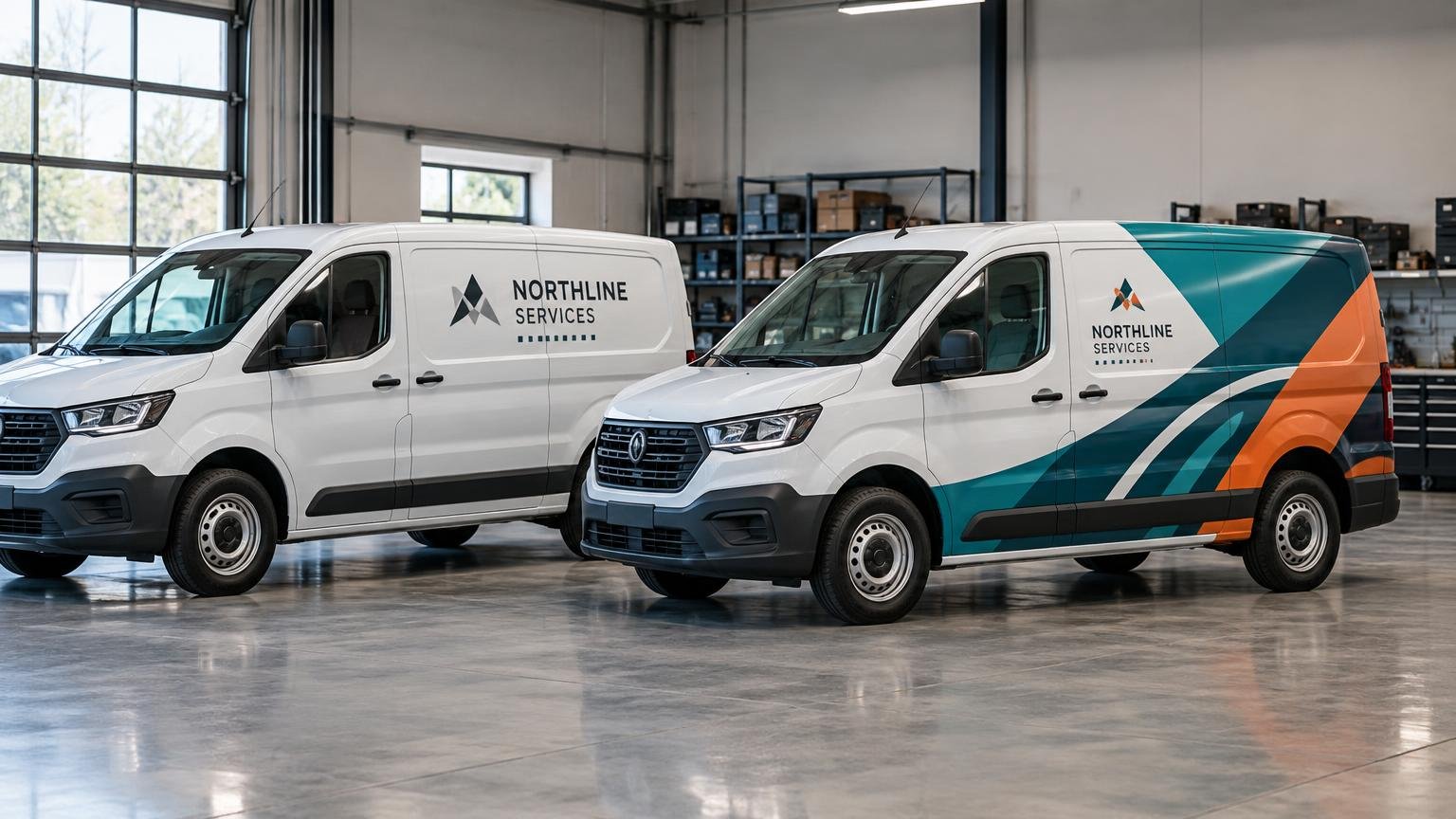
Choose cut vinyl lettering when the vehicle mainly needs a readable business name, phone number, website, service description, or unit number. Choose a full or partial wrap when the design depends on photographs, gradients, illustrations, large color fields, or branding that crosses several body panels. For many service vehicles, the strongest answer is a hybrid: a printed partial wrap for visual impact and separate cut lettering for information that may change.
If you are asking “vehicle wrap vs cut vinyl lettering which does a business vehicle need,” start with the message rather than the square footage. A full wrap is not automatically more professional, and lettering is not automatically a budget substitute. The right format is the one that makes the business recognizable and the important copy readable without adding unnecessary production, installation, or replacement complexity.
Vehicle wrap vs cut vinyl lettering: the practical difference
Cut vinyl lettering is made by cutting letters, numbers, and simple shapes from colored adhesive film. Unwanted material is removed, and transfer tape holds the remaining design in position during application. Because the color comes from the film itself, this format works especially well for solid-color text, uncomplicated logos, registration numbers, and restrained door graphics.
The material still matters. ORAFOL, for example, describes ORACAL 951 as a premium cast plotter film suitable for automotive graphic markings and vehicle advertising. That places it in a different category from generic craft vinyl and illustrates why a quote should identify the actual film rather than merely say “vinyl lettering.” Businesses with production-ready artwork can also compare transfer-style vehicle decals and custom graphics as a commercial alternative for simple applications.
A printed vehicle wrap uses printable graphic film to reproduce colors and imagery that cannot be assembled efficiently from separate pieces of solid-color vinyl. A typical printed system may include film, ink, and a compatible laminate. Coverage can range from a small printed door graphic to a partial wrap or a design spanning most of the vehicle. ORAFOL describes ORAJET 3951RA+ ProSlide as a printable cast PVC film intended for commercial and complex vehicle-wrap applications, but its published performance remains conditional on the specified system and use conditions.
Do not confuse coverage with material construction. Both cut graphics and printed wraps can use different film families. Vehicle shape, expected service conditions, approved surfaces, and the manufacturer’s application guidance should drive the choice. The distinction between cast and calendared vehicle film becomes particularly important around compound curves, recesses, and other demanding geometry.
Choose lettering when identification is the main job
Cut lettering is usually the cleanest choice when the vehicle needs to communicate a short list of facts. Think of a white service van with a two-color logo, company name, phone number, web address, and vehicle number. Those elements do not need a large printed background to work. Strong contrast, sensible placement, and disciplined copy will do more for readability than covering another panel.
Lettering also makes selective changes easier. If a business expects to update a phone number, service area, certification line, or unit identifier, keeping that information separate from the main graphic system can avoid replacing a much larger printed panel. This does not mean every letter can be removed and replaced invisibly; film age, paint exposure, residue, fading, and surface condition can make old and new areas look different.
The main design constraint is simplicity. Plotter-cut graphics are well suited to solid-color shapes, but photographs, soft shadows, detailed illustrations, and complex gradients generally point toward printing. A multicolor logo can be assembled from separate films, although registration becomes more demanding as the number of colors and small components grows.
Choose a wrap when the image needs coverage and color
A wrap earns its place when the vehicle itself is meant to become a broad visual canvas. That may mean a photographic product image on a delivery van, an illustrated campaign across the side of a box truck, or a large branded color field that connects the doors, quarter panels, and rear of a vehicle.
A partial wrap may be enough. Concentrating printed coverage on the rear half of a van, a large side panel, or the bed of a pickup can create a strong silhouette without treating every painted panel as necessary advertising space. The design should look intentionally cropped rather than like an incomplete full wrap. Natural body lines, trim, and panel transitions can provide convincing endpoints.
Vehicle geometry raises the production stakes. Recesses, rivets, handles, sensors, moldings, compound curves, and panel gaps affect artwork placement as well as installation. Important text should not be split by a door seam or forced deep into a recess. Faces and product details need safe placement, and backgrounds must provide enough bleed for installation alignment.
For fleets, the wrap decision should also account for different vehicle bodies. A layout built for a long-wheelbase cargo van will not simply shrink onto a sedan or pickup. A better approach is to define repeatable brand elements, copy hierarchy, colors, and safe zones, then adapt them by vehicle class. Our guide to designing a fleet wrap system across vans, trucks, and cars explains that process in more detail.
A hybrid system is often the best business choice
A partial printed wrap paired with cut lettering handles the middle ground well. Use the printed component for the logo treatment, illustration, texture, or branded color block. Apply the phone number, URL, service list, unit number, or required identifiers as separate cut graphics.
This approach can improve flexibility without making the design feel pieced together. A plumbing company might use a bold printed water graphic along the lower side of a van, then place high-contrast cut lettering on the upper door. A catering company could use one printed food image on the rear quarter and reserve the front doors for a simple logo and contact details. A mixed fleet could repeat the lettering hierarchy on every vehicle while scaling the printed accent to suit available panel space.
The hybrid approach is not automatically less expensive. It can introduce additional setup, plotting, weeding, transfer-tape work, and installation steps. Ask for comparable quotes based on the final artwork, named materials, preparation, installation, removal of existing graphics, and any future replacement needs. Comparing only the amount of vinyl ignores much of the actual work.
Decision matrix for a business vehicle
| Business need | Best starting format | Why |
|---|---|---|
| Company name, phone number, URL, and unit number | Cut vinyl lettering | Keeps simple identifiers clear and avoids unnecessary printed coverage. |
| Photographs, gradients, detailed illustration, or large background colors | Printed full or partial wrap | Reproduces complex artwork and carries it across larger areas. |
| More impact than lettering without covering the whole vehicle | Partial wrap plus cut lettering | Combines a strong visual element with flexible informational copy. |
| Mixed fleet with changing numbers or service details | Modular lettering or a hybrid system | Allows stable brand graphics and variable information to be managed separately. |
| Damaged, rusty, peeling, or uncertain paint | Inspection and repair before choosing | Graphics follow the substrate and should not be treated as body repair. |
Check the vehicle and artwork before ordering
The design file is only half of the project. The installer also needs an accurate understanding of the vehicle, its surfaces, and the proposed placements. Review the following before approving production:
- Confirm the exact year, make, model, body configuration, roof height, wheelbase, and installed accessories.
- Provide usable vector logo files where possible, along with approved colors and final copy.
- Prioritize the company name and primary action over a long list of services.
- Check text size and contrast at realistic viewing distance rather than only on a monitor.
- Measure the actual vehicle and identify seams, handles, trim, emblems, recesses, rivets, sensors, and repaired panels.
- Decide which information is permanent and which elements may need individual replacement.
- Verify required contractor, carrier, fleet, DOT, reflective, or jurisdiction-specific markings before production.
- Ask the provider to name the film, laminate where applicable, preparation scope, installation assumptions, and warranty conditions.
Surface condition deserves particular attention. 3M’s substrate-selection and preparation guidance identifies surface condition, cleaning, preparation, and contaminants as factors relevant to graphic-film adhesion. Wax, grease, road contamination, coatings, corrosion, failing clear coat, and poorly bonded repaint work can undermine an otherwise sound graphics plan.
A wrap or decal follows the surface beneath it; it does not repair scratches, dents, rust, or peeling paint. Some minor defects may remain workable after inspection, while failing surfaces can require repair before graphics are installed. Use the vehicle-condition checklist in our guide to wrapping over scratches, dents, rust, or peeling paint before assuming additional coverage will hide the problem.
Installation, care, removal, and warranty are system-specific
Do not choose between lettering and a wrap based on a blanket lifespan promise. Exposure orientation, climate, film color, ink, laminate, substrate, cleaning, storage, installation quality, and vehicle use can all affect the result. A manufacturer’s warranty may also depend on using compatible components and following its published processing and installation requirements.
Installation time is similarly project-specific. Simple door lettering and a complex wrap do not require the same preparation or application scope, but vehicle condition, old-graphic removal, shop scheduling, cure requirements, panel complexity, and quality-control work prevent a responsible universal downtime estimate. Get the planned drop-off, preparation, installation, inspection, and pickup schedule in writing.
Care should follow the film or graphics-system manufacturer’s current instructions. Aggressive chemicals, careless pressure washing, hard scrubbing at exposed edges, and neglected contamination can shorten useful service. Report lifting edges or damage early rather than allowing water and dirt to work farther beneath the graphic.
Removal is not risk-free. Results depend on the adhesive, dwell time, exposure, removal technique, paint condition, and whether panels were repainted. Ask how existing graphics will be evaluated and removed, especially on older vehicles or vehicles with an uncertain repair history. Neither lettering nor a wrap should be sold with an unconditional promise that the paint cannot be affected.
Make the decision from the message outward
Start with cut vinyl lettering if your business vehicle mainly needs clean, readable identification. Move to a partial or full printed wrap when complex artwork and broad panel coverage are essential to the brand concept. Choose a hybrid when you want one memorable visual device but also need phone numbers, URLs, fleet identifiers, or service details that can be replaced separately.
Before approving the job, simplify the copy, inspect the paint, map the actual panels, and require the quote to identify the material system and installation scope. That process will produce a better business vehicle than choosing “wrap” or “lettering” as a status decision. The graphic format should serve the message, fit the vehicle, and remain practical to maintain and update.