
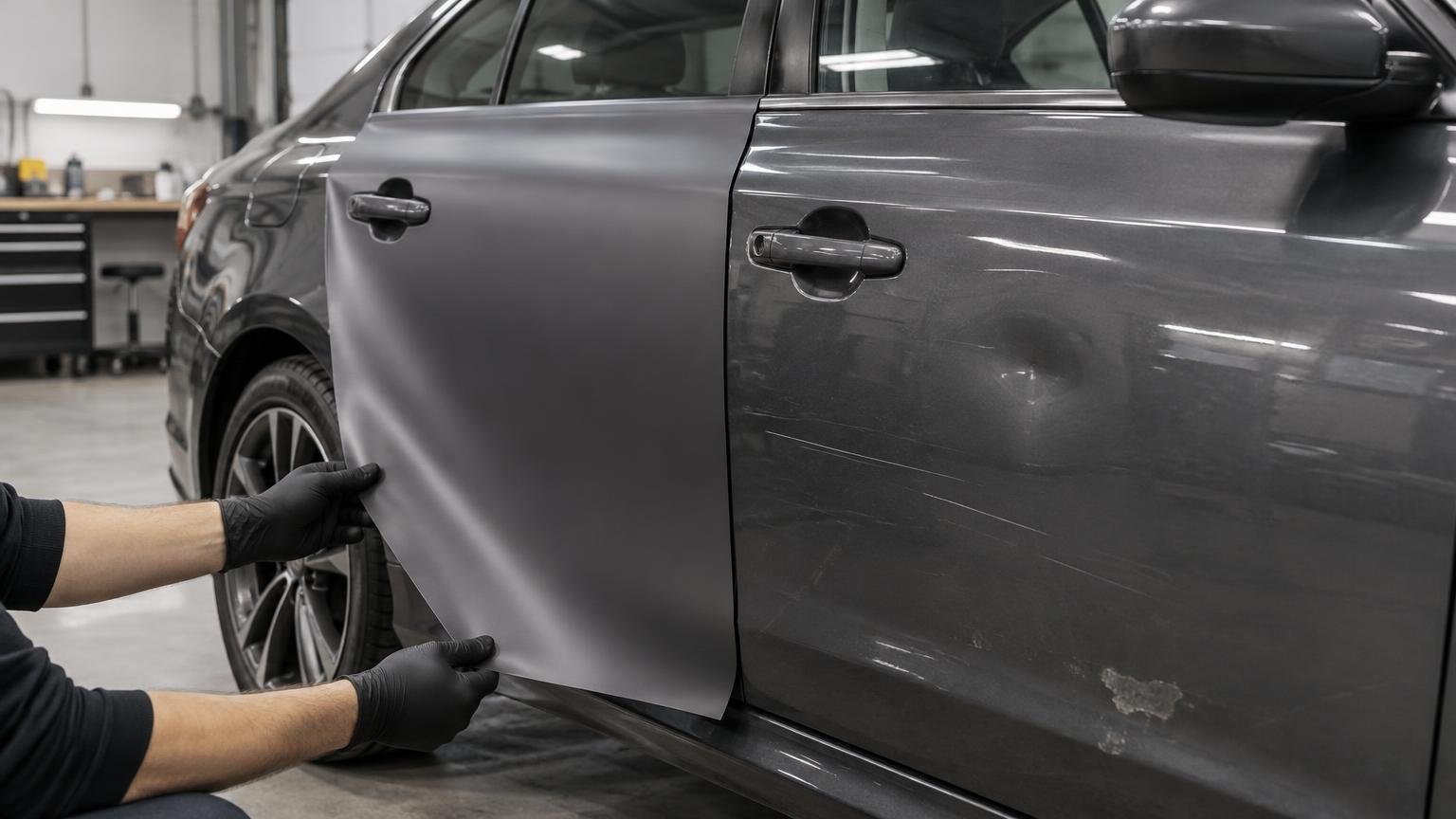
TLDR
You can sometimes wrap over light scratches or a shallow, smooth dent when the paint remains sound, but the film will not repair or reliably conceal the defect. Rust, peeling clear coat, blistered paint, loose paint, sharp dents, and unstable repairs should be corrected first. Judge every affected panel on three points: how it will look, whether the film can adhere, and whether eventual removal could pull off weak paint.
If you are asking can you wrap over scratches, dents, rust, or peeling paint, the practical answer is not simply whether vinyl will stick today. The underlying surface must also remain stable through installation, use, and removal. Film conforms closely to panel texture, so many defects remain visible and some can cause premature failure. 3M specifically identifies rust, bubbling, scratches, dents, and other defects as conditions that may show through film or impair performance.
Can you wrap over scratches, dents, rust, or peeling paint?
Minor, smooth, firmly bonded cosmetic flaws may be acceptable if the owner understands that the finished wrap will not look like it was installed over a perfect panel. Anything loose, corroded, blistered, sharply distorted, or poorly bonded is a repair-first condition.
A wrap behaves more like a new skin than bodywork. It follows low spots, raised edges, chips, sanding marks, orange peel, and panel distortion. A defect may become less obvious when the vehicle changes color, but that is a change in visual perception—not a repair. High-gloss film can make underlying orange peel particularly apparent because reflected light reveals variations in the surface.
| Existing condition | Wrap now? | Practical recommendation |
|---|---|---|
| Very light scratch with intact, smooth paint | Possibly | Inspect it by sight and touch. If the mark has no raised or loose edge, wrapping may be an acceptable cosmetic compromise. |
| Deep scratch or paint chip | Usually repair first | Address exposed substrate, hard edges, and loose paint before installation. |
| Shallow, broad dent with intact paint | Sometimes | Consider paintless dent repair first if appropriate. The wrap will follow the dent rather than level it. |
| Sharp dent or crease | Repair first | The distortion will remain visible and can make film application more difficult. |
| Surface rust or bubbling corrosion | No | Remove and repair the corrosion, then refinish and allow the coating to cure. |
| Peeling paint or failing clear coat | No | Remove the unstable coating and refinish the panel. Film cannot stabilize a failing paint system. |
| Body filler or primer | Condition-dependent | The repair must be smooth, stable, properly refinished where required, and compatible with the selected film system. |
| Newly painted panel | Wait | Follow the paint maker's cure guidance and the film manufacturer's current instructions before wrapping. |
Light scratches may be acceptable, but depth matters
A faint clear-coat scratch that feels smooth and has no loose edge is the most plausible candidate for wrapping without body repair. Even then, inspect it under angled light. Gloss film can reveal a line that looked insignificant on dull or dirty paint.
A deep scratch is different. If it has cut through the coating, exposed the substrate, created a hard ridge, or left paint ready to flake, covering it is a poor shortcut. The film may bridge the damaged area initially, but it does not restore corrosion protection or make the coating beneath it stable.
Do not assume that installer primer can rescue bad paint. 3M warns that applying primer over an unsound painted surface does not guarantee successful film performance or warranty coverage. The correct preparation depends on the defect and selected product, but loose coatings must be treated as a repair problem rather than an adhesion problem.
A car wrap will not hide a dent
Vinyl can cover a dent in the literal sense, but it cannot flatten one. A broad, shallow dent may be less noticeable under a low-reflection finish, while a sharp crease will usually remain obvious. Reflections bend across the distorted panel, and the film follows that shape.
If the paint is intact and the dent is suitable for paintless dent repair, arrange that work before wrapping. This can preserve the existing finish while restoring a smoother panel. A crease, stretched metal, cracked paint, or previous body repair may require a different repair process, so the panel should be assessed in person.
The installer also needs to consider tension and edge placement. A dent or crease can create an irregular surface where the film must change direction abruptly. That does not automatically make installation impossible, but it can make the appearance and long-term result less predictable.
Rust must be repaired, not covered
Do not wrap over rust as a temporary cosmetic fix. Corrosion is an unstable substrate, and bubbling often indicates that deterioration extends beyond what is visible at the surface. Vinyl does not remove corrosion, restore the coating system, or provide a dependable repair.
The affected area should be evaluated, repaired, refinished, and fully cured before wrapping. The necessary work depends on how far the corrosion has progressed. Installing film over a bubbling spot may conceal it briefly, but the changing surface can remain visible and contribute to premature film failure.
Peeling paint and failing clear coat are removal risks
Peeling paint, lifting clear coat, and blistered coatings are poor foundations for any wrap. Adhesive performance depends partly on the strength of the surface to which it is attached. If that surface separates from the vehicle, the wrap cannot keep the finish intact.
Weak paint also creates risk at removal. Avery Dennison advises documenting chips, scratches, touch-ups, aftermarket finishes, and compromised clear coat because damaged or weak coatings can be vulnerable to paint pull when graphics are removed. A successful installation today therefore does not prove that removal will be trouble-free later.
Repainted panels deserve special attention even when they look good. The shop should know about aftermarket paint, touch-ups, body filler, previous collision repair, and areas where clear coat has been corrected. That history helps the installer assess suitability and explain risks before the wrap is approved.
Will matte or satin film hide the damage?
A less-reflective finish can reduce the visual contrast of some shallow waves, fine scratches, or orange peel. It may therefore be more forgiving than high gloss under certain lighting. That does not make matte or satin film a substitute for surface preparation.
Finish choice cannot stabilize peeling clear coat, stop corrosion, flatten a dent, or remove the ridge around a chip. It should be made after the panel is judged suitable for wrapping. Material construction matters too: once the surface is sound, compare the demands of the vehicle and coverage area when choosing cast or calendared vinyl wrap.
What about body filler, primer, and fresh paint?
A repaired panel should not be treated as wrap-ready merely because filler or primer looks smooth from a few feet away. The complete repair needs to be stable, smooth, and prepared for the selected film system. 3M recommends a like-new finish for protection wrap film and says repaired areas should be properly prepared, refinished, and fully cured before installation.
There is no responsible universal waiting period for every newly painted panel. Paint chemistry, repair method, environmental conditions, and film instructions vary. Follow the refinishing product manufacturer's cure guidance and the current instructions for the exact wrap film. “Dry to the touch” should not be treated as automatic approval for wrapping.
Use a three-part inspection before approving the wrap
A surface assessment should answer three separate questions. Passing one does not guarantee the panel passes the others.
- Appearance: Will scratches, sanding marks, chips, texture, dents, repair edges, or orange peel remain visible through the chosen finish?
- Adhesion: Is the surface clean, smooth, compatible, and firmly bonded, with no corrosion, loose paint, blistering, wax, contamination, or unstable repair material?
- Removal: Is the underlying finish strong enough to tolerate later film removal, particularly around touch-ups, chips, repainted panels, and compromised clear coat?
Inspect the vehicle clean and dry, under useful lighting, and from several angles. Run a hand carefully over questionable areas to detect raised chip edges, rough repairs, or texture that photographs may miss. An in-person assessment is more useful than trying to approve a damaged panel from distant images alone.
Document the condition before installation. Photographs and written notes should identify chips, scratches, dents, corrosion, clear-coat failure, touch-ups, repainted panels, and prior body repairs. This creates a shared understanding of what the wrap is expected to conceal, what may remain visible, and which areas present added removal risk.
The practical decision
Wrap a flawed panel only when the defect is minor, smooth, stable, and acceptable as a visible cosmetic compromise. Repair first when there is rust, bubbling, peeling paint, failing clear coat, exposed or loose substrate, a sharp dent, or an unstable previous repair.
Before choosing color or finish, arrange an in-person assessment of every affected panel. Ask the installer to separate appearance concerns from adhesion and removal risks, then obtain the appropriate body or paint repair where needed. The best wrap starts with a surface that is sound enough to support both a clean installation and a controlled removal later.